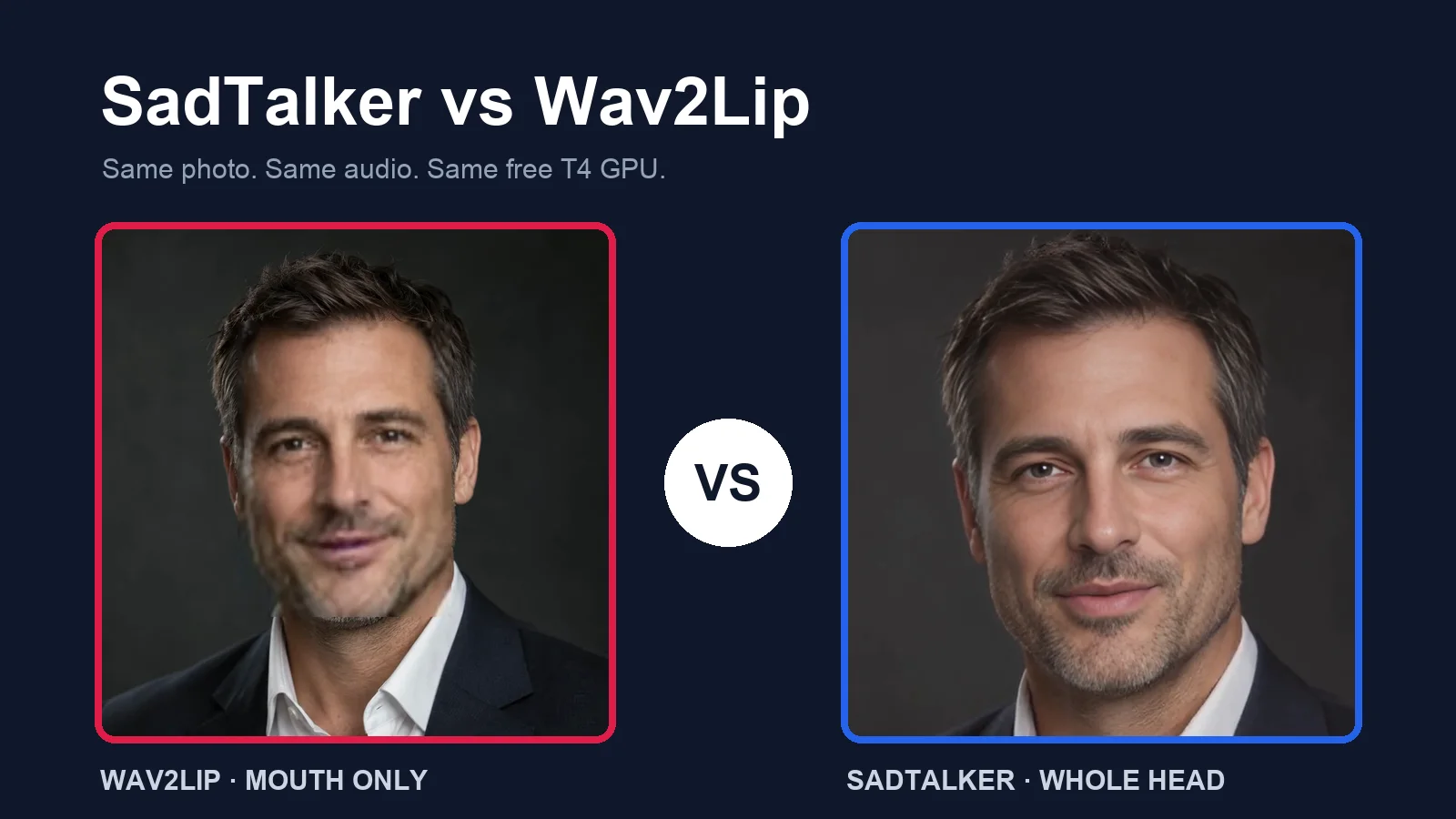
01 / QUICK VERDICT
Which lip-sync tool fits which job
- SadTalker: best when you start from one photo. It animates the whole head: lips, expressions, blinks and head motion. Free, Apache 2.0.
- Wav2Lip: best when you already have a video and only need the mouth to match new audio. Fast, but the mouth region is low resolution, and it is licensed for non-commercial use only.
- Sync Labs: the paid, commercial successor to Wav2Lip for dubbing real video. Cloud only, billed per second.
02 / HOW THEY WORK
How AI lip sync works in each tool
SadTalker (CVPR 2023) predicts 3D face motion from the audio: expression coefficients for the lips and face, and a separate head-pose model. A renderer then animates your photo frame by frame, so the whole head moves.
Wav2Lip (ACM Multimedia 2020) detects the face in each frame, masks the lower half, and generates a new mouth from the audio. A “lip-sync expert” network trained it to match speech closely. It works at 96 × 96 pixels and pastes the mouth back into the frame; everything outside the mouth stays as it was.
Sync Labs is a hosted service from the same team. Its current models (lipsync-2, lipsync-2-pro, sync-3) run in the cloud on uploaded video and audio; the Wav2Lip README calls the commercial version “of a much higher quality” than the open-source model.
03 / ORIGINAL TEST
Same photo, same audio, same T4 GPU
One portrait, one 11.3-second WAV, one free Google Colab T4 (15 GB). Each tool ran from a fresh command, so times include model loading. GPU memory was sampled every half second with nvidia-smi.
On a small screen, swipe the table sideways.
| Run | Time | GPU memory used | Output |
|---|---|---|---|
| Wav2Lip GAN | 53 s | 10.7 GB | 1116 × 1034 · 25 fps · 11.3 s |
| SadTalker 256, crop | 113 s | 3.2 GB | 256 × 256 · 25 fps · 11.2 s |
| SadTalker 512, crop, still, GFPGAN | 540 s | 8.5 GB | 1024 × 1024 · 25 fps · 11.2 s |
Time is the full command, including model loading. GPU memory is the peak above the idle baseline. One run each on a shared free GPU, so treat small differences as noise.
Look closely: the mouth
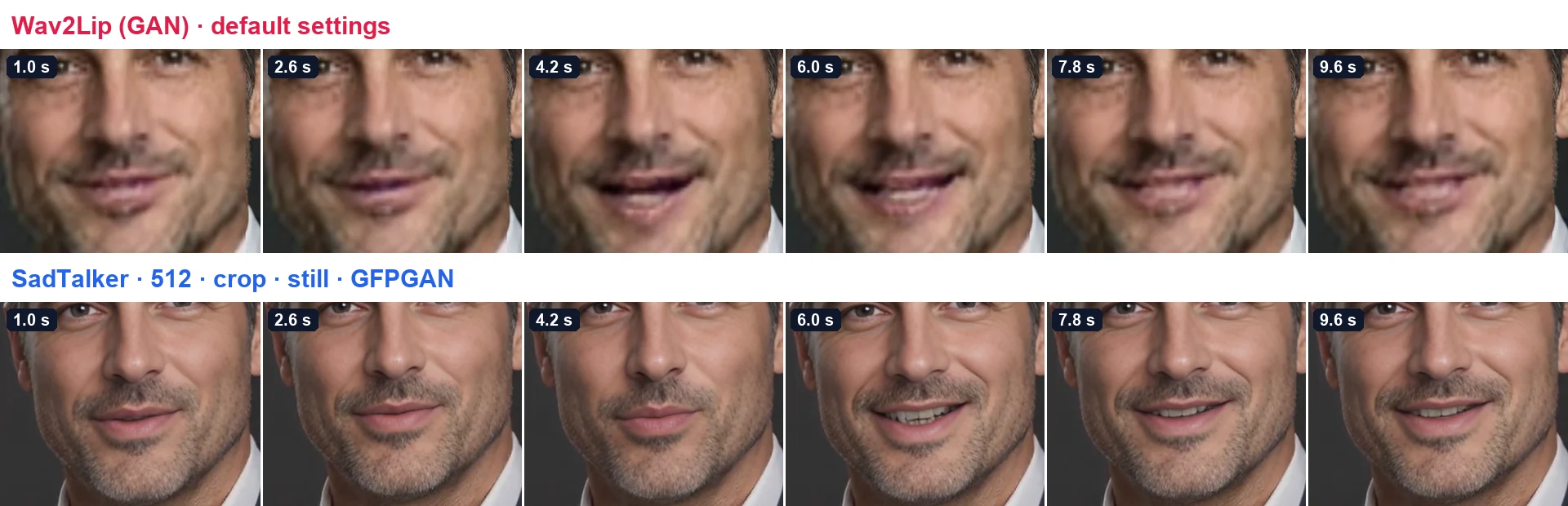
- Mouth movement: Wav2Lip opens and closes the mouth wider and more clearly with each word. SadTalker’s mouth shapes are smaller and calmer.
- Detail: Wav2Lip’s mouth is generated at 96 × 96 pixels and stretched back over a 1116 × 1034 photo, so the whole lower face turns soft and the lips pick up a purple tint. SadTalker at 512 with GFPGAN keeps sharp skin, stubble and teeth.
- Seams: Wav2Lip leaves a visible horizontal edge under the chin where the patch is pasted back. SadTalker renders the whole face, so there is no patch edge.
- The rest of the face: with a still photo, Wav2Lip moves only the mouth; eyes and head stay frozen. SadTalker adds blinks and expression (still mode keeps the head steady; turn it off for head motion).
- GPU memory: Wav2Lip used the most, 10.7 GB, mostly because its face detector processes the full-size photo. Lowering
--resize_factoror the face-detection batch size reduces it.
04 / AT A GLANCE
Quality, speed and VRAM compared
On a small screen, swipe the table sideways.
| SadTalker | Wav2Lip | Sync Labs | |
|---|---|---|---|
| Mouth movement (our test) | Follows the words with smaller, calmer shapes | Wider, clearer shapes that follow the words | Commercial lipsync-2 models; the Wav2Lip README calls them much higher quality |
| Face detail | Sharp, especially at 512 + GFPGAN | Soft 96 px mouth patch | Up to 4K with lipsync-2-pro |
| Head motion | Generated (or still mode) | None; follows the source video | Follows the source video |
| Speed on a T4 (our test) | 113–540 s | 53 s | Runs in the cloud |
| GPU memory (our test) | 3.2–8.5 GB | 10.7 GB | None; runs in the cloud |
| Cost | Free (your GPU) | Free (your GPU), non-commercial | From $5/mo + per second |
05 / FEATURES
Feature comparison
On a small screen, swipe the table sideways.
| SadTalker | Wav2Lip | Sync Labs | |
|---|---|---|---|
| Input | One photo + audio | Video or photo + audio | Video + audio (the site describes video content) |
| Animates from a single photo | Yes, whole head | Mouth only; rest stays still | Built for video input |
| Open source | Yes | Yes | No |
| Licence | Apache 2.0 | Personal, research or non-commercial only | Commercial subscription |
| Runs on | Your NVIDIA GPU, Colab, or a Space | Your NVIDIA GPU or Colab | Sync cloud, web app or API |
| Watermark | None | None | Hobbyist plan only |
| Max length | Your time and GPU | Your time and GPU | 1–30 min by plan |
06 / SYNC LABS
Sync Labs pricing
From Sync Labs’ public pricing page, checked 24 November 2026. Each plan has a monthly fee plus a per-second charge for the model you use; there is no free plan listed.
On a small screen, swipe the table sideways.
| Plan | Monthly fee | Max video length | Watermark |
|---|---|---|---|
| Hobbyist | $5/mo | 1 min | Yes (Sync watermark) |
| Creator | $19/mo | 5 min | No |
| Growth | $49/mo | 10 min | No |
| Scale | $249/mo | 30 min | No |
On a small screen, swipe the table sideways.
| Model | Hobbyist | Creator | Growth | Scale |
|---|---|---|---|---|
| lipsync-2-pro | $0.08325 | $0.08325 | $0.07925 | $0.06675 |
| lipsync-2 | $0.05 | $0.05 | $0.0475 | $0.04 |
| lipsync-1.9.0 (legacy) | $0.025 | $0.025 | $0.02375 | $0.02 |
At the lipsync-2 rate of $0.05 per second, one minute of lip-synced video costs about $3 on Hobbyist or Creator, on top of the monthly fee.
07 / DECIDE
When to use which
On a small screen, swipe the table sideways.
| You have… | Use | Why |
|---|---|---|
| One photo and a voice recording | SadTalker | The only one that animates a whole head from a still photo |
| A video to re-voice, for personal use | Wav2Lip | Fast, free, keeps the original motion |
| A video to dub for a client or product | Sync Labs | Commercial licence and higher-quality models |
| A video and you need open source with a commercial-friendly licence | MuseTalk | MIT code; lip-syncs existing video, built for real time |
| No GPU | SadTalker on Colab | Runs on the free T4, as in this test |
Compare more tools: SadTalker vs MuseTalk, SadTalker vs LivePortrait, the open-source digital human stack, and paid studios like HeyGen.
08 / SETUP
Run Wav2Lip on a current Colab
Wav2Lip was written for Python 3.6, and its official weight links point to a SharePoint folder that often blocks scripts. This is what worked for us on 24 November 2026:
- Use a separate Python 3.8 environment (we reused the one from our SadTalker Colab guide) with PyTorch 2.0.1.
- Clone the repository and download
wav2lip_gan.pthand thes3fdface detector from a public Hugging Face mirror. - Patch
audio.pyfor current librosa:librosa.filters.mel(sr=hp.sample_rate, n_fft=hp.n_fft, …). - Run
python inference.py --checkpoint_path checkpoints/wav2lip_gan.pth --face photo.png --audio voice.wav.
For a sharper mouth, the README suggests trying --resize_factor, and adjusting --pads to include the chin.
09 / QUICK HELP
Frequently asked questions
Is SadTalker better than Wav2Lip?
They do different jobs. SadTalker generates a whole talking head from one photo, with head motion and expressions. Wav2Lip only redraws the mouth on an existing video or photo, so the rest of the face stays still.
Which has better lip sync, SadTalker or Wav2Lip?
In our same-input test Wav2Lip opened the mouth wider and more clearly with the words, but its 96-pixel mouth patch left the lower face soft with a seam under the chin. SadTalker produced a sharper, more natural face with smaller mouth movements. See the side-by-side results on this page.
What is Sync Labs?
Sync Labs (sync.so) is a paid cloud lip-sync service from the authors of Wav2Lip. The official Wav2Lip repository now points commercial users to its API and says the commercial version is of much higher quality than the open-source model.
Is Wav2Lip free for commercial use?
No. The Wav2Lip repository says it can only be used for personal, research or non-commercial purposes. SadTalker’s code is Apache 2.0. Sync Labs is the paid commercial route.
How much does Sync Labs cost?
From $5 a month (Hobbyist, 1-minute videos, with a watermark) to $249 a month (Scale), plus a per-second fee per model: for example $0.05 per second for lipsync-2 on Hobbyist and Creator. Prices checked 24 November 2026.
Can Wav2Lip animate a still photo?
Yes. Pass a JPG or PNG as --face and it lip-syncs the mouth while the rest of the image stays still. For head movement and expressions from a single photo, use SadTalker.
Why does Wav2Lip fail on new Python versions?
Its code targets Python 3.6 and old library versions. On current librosa it fails in audio.py; changing the filters.mel call to use keyword arguments (sr= and n_fft=) fixes it, as shown on this page.
SOURCES
- Our same-input test on Google Colab T4 (15 GB), 24 November 2026: results.json
- Wav2Lip official repository (Rudrabha/Wav2Lip) README and licence; SadTalker official repository (OpenTalker/SadTalker)
- Sync Labs public pricing page (sync.so/pricing), checked 24 November 2026